Article · Updated August 2026
Stop checking five dashboards every morning
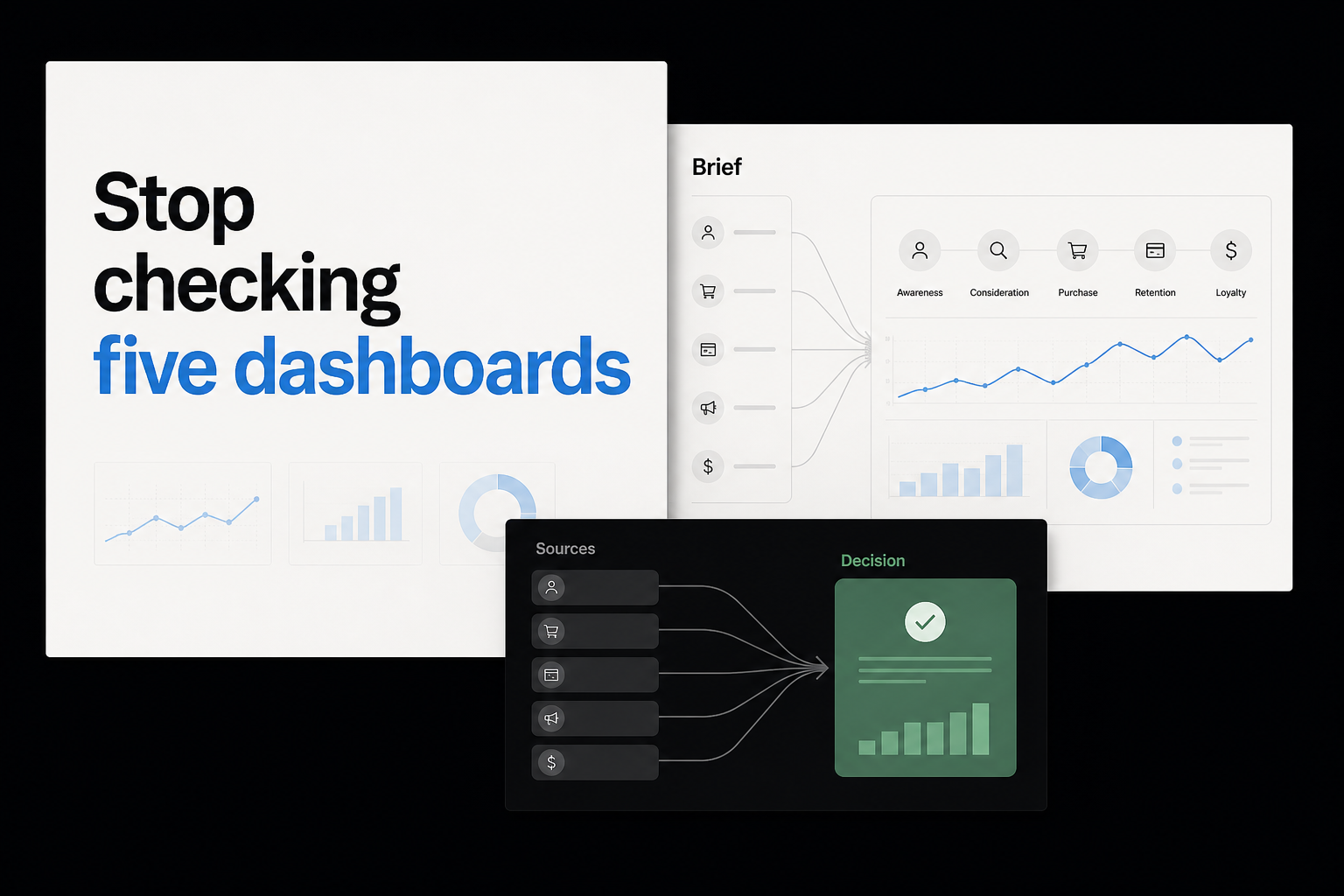
Opening five dashboards is not the same as running the business. A source dashboard is valuable for detailed investigation. A founder brief is valuable for deciding where investigation is needed.
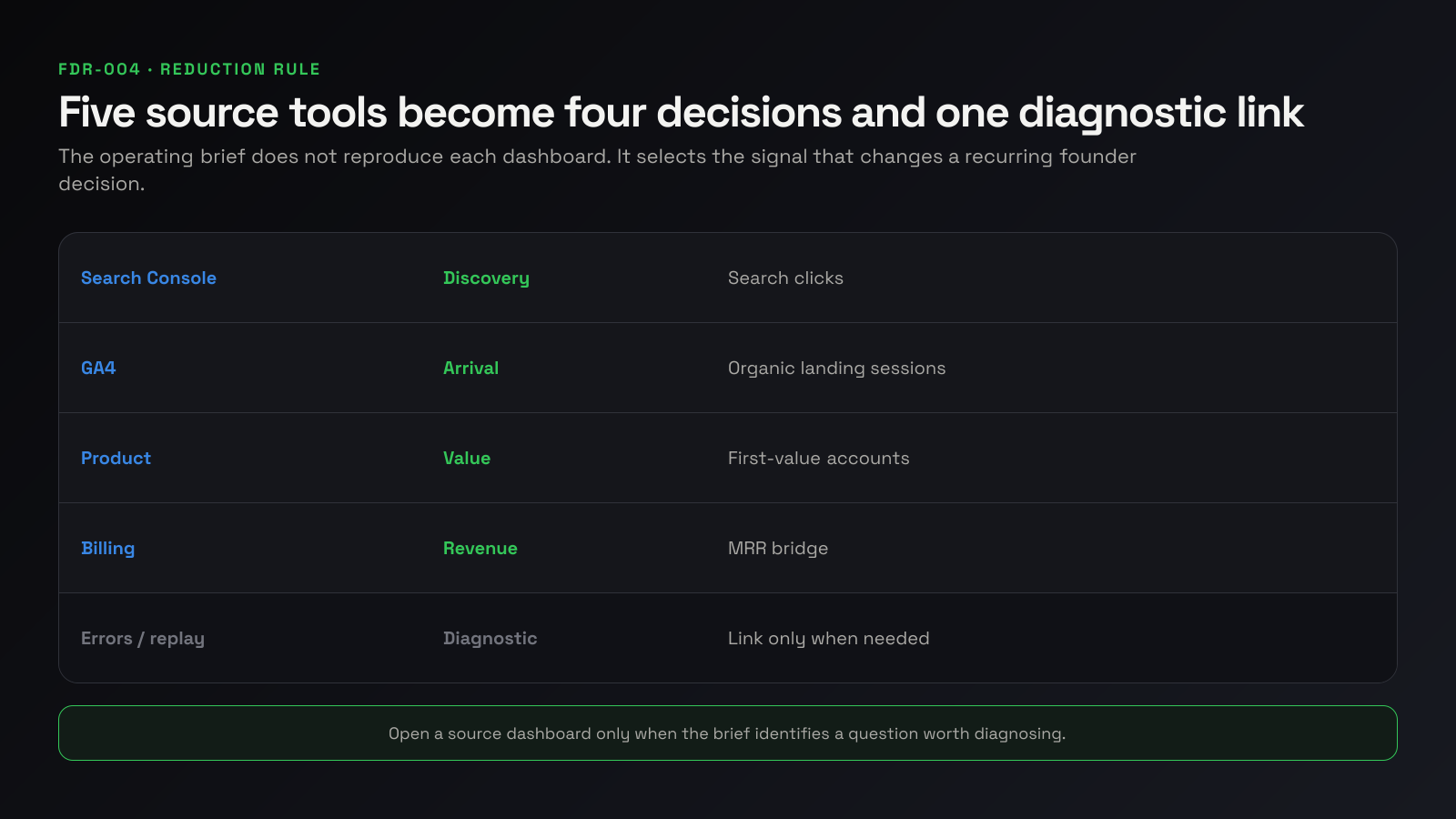
Replace the morning loop with four recurring decisions and one diagnostic link.
Audit the current loop
For one week, record:
| Dashboard | What you looked at | Decision changed? | Follow-up? |
|---|---|---|---|
| Search Console | Click trend | No | None |
| GA4 | Sessions | No | None |
| Product analytics | Activation funnel | Yes | Inspect connection step |
| Billing | MRR | No | None |
| Replay/errors | Recent sessions | No | None |
If a check rarely changes a decision, remove it from the daily routine. Keep the tool available for investigation.
Classify each check:
| Type | Meaning | Treatment |
|---|---|---|
| Operating | Repeated signal tied to a decision | Put one metric in the brief |
| Diagnostic | Used after a problem is located | Keep as a deep link |
| Incident | Needs immediate response | Create an alert/runbook |
| Curiosity | Interesting without a recurring action | Explore intentionally, not every morning |
This prevents error monitoring and session replay from competing with weekly retention for permanent space.
Define the operating questions
- Is discovery materially changing?
- Do eligible accounts reach first value?
- Does value become and remain revenue?
- Is a source stale or broken?
- Which one issue will we diagnose next?
Each question gets one top-line signal, definition and source link.
Build the brief
| Decision | Signal | Source | Open source when… |
|---|---|---|---|
| Discovery | Search clicks or qualified arrivals | Search Console/GA4 | Page or source movement crosses the review threshold |
| Activation | First-value accounts and rate | Product analytics | A mature cohort loses materially more accounts |
| Revenue | MRR bridge | Billing/subscription | The bridge does not reconcile or loss changes |
| Trust | Freshness and connection state | Every source | Data is late, partial or disconnected |
| Diagnostic | One deep link | Errors/replay/source detail | The brief names a specific hypothesis |
Use a complete weekly window for normal operating decisions. Keep alerts for true incidents such as payment failures or broken ingestion; do not turn every metric into an alert.
The brief should fit one screen in customer order:
- context and source health;
- discovery/arrival;
- first value;
- mature paid conversion;
- revenue movement/retention;
- next diagnostic.
On mobile, keep that order vertically. Do not squeeze five source layouts into a small grid.
Set review thresholds
A threshold is a trigger to inspect, not proof of a problem. Examples:
- source is later than its expected refresh window;
- absolute activation loss rises by a stated amount;
- revenue bridge fails to tie;
- trial cohort is mature and conversion leaves its normal operating range;
- one source/page/product drives a material share of the change.
Avoid arbitrary red/green rules copied from another business. Establish thresholds from your decision cadence and data variability.
A fictional before-and-after
Before:
- 20 minutes opening tools;
- four different date ranges;
- three unexplained mismatches;
- no written action.
After:
| Signal | Current | Prior | Interpretation |
|---|---|---|---|
| Search clicks | 1,120 | 980 | Discovery rose; source complete only through Friday |
| Activated accounts | 79 | 82 | Absolute activation fell despite more entries |
| Ending MRR | $12,480 | $12,100 | Net growth positive; churn increased |
| Source health | 3 current, 1 delayed | 4 current | Search comparison partial |
Action: inspect the account-to-first-value funnel for the latest mature cohort, then sample failed and successful sessions. The founder opens product analytics and replay with a named job; the other tools stay closed.
Keep source definitions intact
The brief should say whether a value is a click, session, account, device, customer, transaction, proceeds or MRR. It should show the window and freshness. Combining source cards without these labels merely creates a sixth dashboard.
Use a definition registry:
| Brief signal | Owner | Source link | Definition change rule |
|---|---|---|---|
| Search clicks | Search Console | Performance page filter | Source definition preserved |
| First value | Product | Funnel/event specification | Version and annotate changes |
| Paid conversion | Billing | Mature trial cohort | Hide incomplete cohorts |
| MRR bridge | Billing | MRR movement | Store configuration snapshot |
The registry makes the reduction reversible: every headline value can be traced to its owner.
Separate alerts from reviews
An alert should lead to an immediate, rehearsed response. Examples include disconnected ingestion, failed-payment spike, elevated purchase errors or unavailable product service.
A review signal develops slowly enough to interpret in context: organic visibility, activation cohorts, trial conversion, retention and recurring-revenue movement.
If every weekly change generates an alert, founders return to compulsive checking under a different name.
Run a two-week reset
Week one
- inventory all dashboard checks;
- record time and decisions;
- choose four operating signals;
- create direct diagnostic links;
- define freshness expectations.
Week two
- open only the brief at the scheduled review;
- follow a source link only for the chosen investigation;
- record whether another missing signal would have changed a decision;
- add nothing unless that question recurs.
At the end, compare time spent, unexplained mismatches, actions produced and source-dashboard opens. The target is better decisions with less assembly, not zero source usage.
What the brief should say when nothing changed
“No action” can be a valid result:
All four sources are current. Acquisition, activation and net MRR remain within the stated operating range for mature cohorts. No diagnostic opened. Next review: 17 Aug.
This is more useful than opening five tools until something looks alarming.
Choose the right cadence
| Signal | Sensible cadence | Exception |
|---|---|---|
| Search visibility | Weekly | Launch or known incident |
| Activation | Weekly mature cohort | Broken event/source alert |
| Trial-to-paid | Cohort maturity | Store/payment incident |
| MRR movement | Weekly/monthly | Failed-payment alert |
| Detailed replay | Diagnostic only | Critical reproducible bug |
Not looking every morning is not neglect. It is matching attention to when the evidence can change.
Automate carefully
Automate values, comparisons, freshness and source links after the brief stabilizes. Do not automate an unsupported causal explanation. A weekly founder report you can build in 30 minutes gives the manual template.
MetricsJar fits the recurring cross-source brief. It does not replace the source tools used to debug queries, events, transactions or recordings.
Evaluate automation by setup, maintenance, credential/data handling, source coverage and saved recurring work. The best analytics stack for a small SaaS provides the full comparison. Staying with a manual weekly brief can be correct when the workflow is already short and trustworthy.
Frequently asked questions
Which dashboards should I stop checking?
Stop routine checks that do not change a recurring decision. Keep the source available and link to it from the brief when a diagnostic is triggered.
Should revenue be checked every day?
Use alerts for payment incidents. Review recurring-revenue movement at the cadence where churn, contraction and new revenue can be interpreted together.
What if I enjoy checking dashboards?
Separate exploration from the operating review. Exploration can be useful, but it should not masquerade as the decision process.
Is one dashboard the answer?
Only if it selects and defines the decision signals. Copying every source chart into one interface preserves the problem.
How do I know the brief is working?
Every review should produce either no action with stated confidence, or one owned investigation. Assembly and interpretation time should fall.
Sources
- Founder who stopped checking five dashboards
- Solo founders comparing dashboard routines
- Daily GA, Search Console, product and purchase checks
- Combined Apple Search Ads, RevenueCat and GA view