Article · Updated August 2026
Founder investor reports without the monthly spreadsheet grind
The slow part of an investor update is rarely writing the opening paragraph. It is finding the current number, reproducing its definition, explaining why it moved and checking that the narrative agrees with the underlying sources.
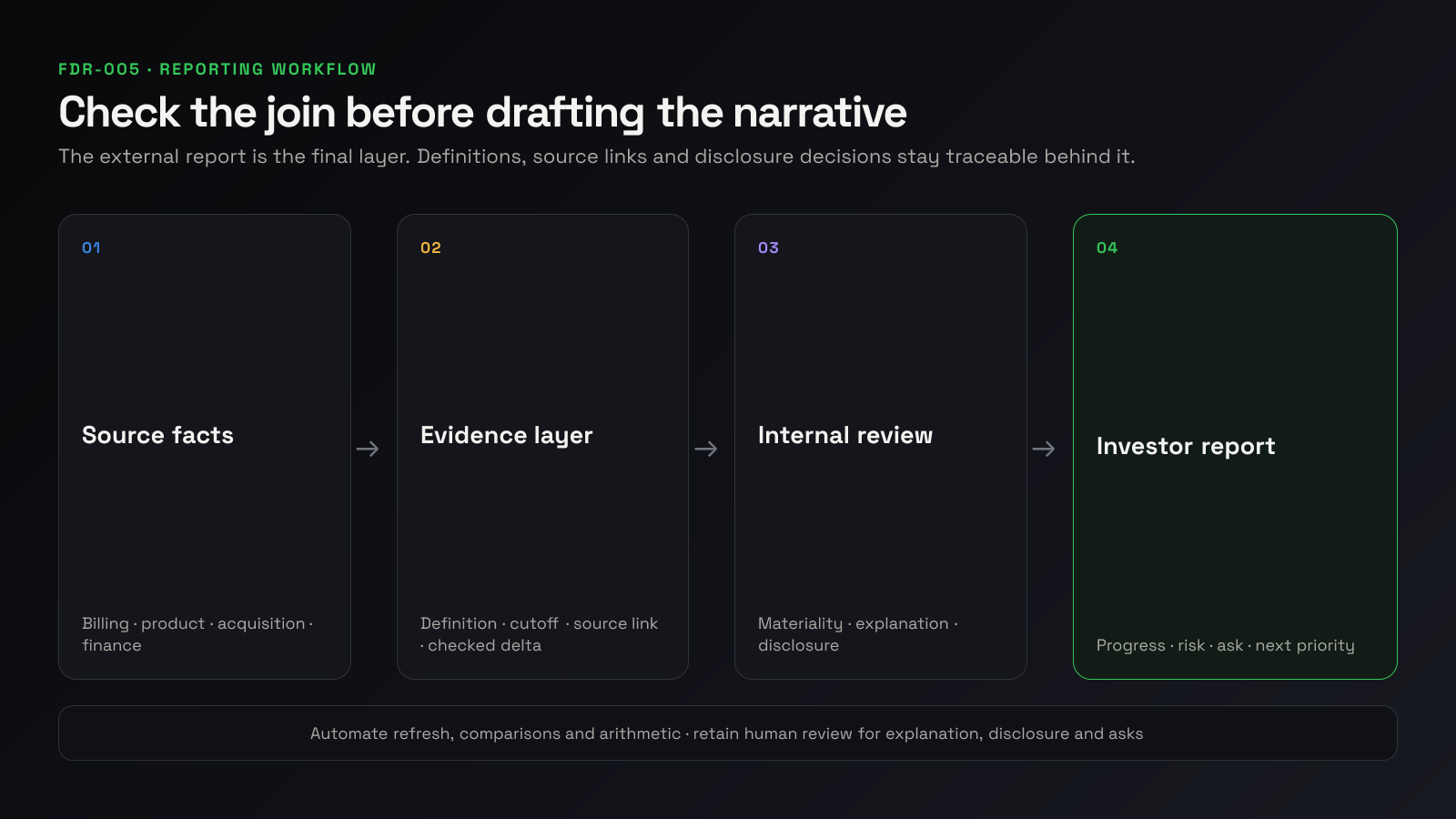
Treat the update as a recurring data product. Join a small set of controlled facts, record the explanation beside each fact, then draft the external narrative from that reviewed layer.
Start with the decision the update serves
An investor update can keep stakeholders informed, surface asks and create a record of how the company is changing. It does not need to reproduce every internal dashboard.
Choose a stable structure:
- short opening summary;
- progress against the current company objective;
- a compact metrics block;
- what changed and why;
- risks or things that are not working;
- specific asks;
- priorities before the next update.
The structure should remain stable enough that readers can compare periods. The content inside it should change when the business changes.
Build a reporting contract
For each recurring number, record its owner, source, definition and reporting delay.
| Report line | Definition | Authoritative source | Freshness | Owner |
|---|---|---|---|---|
| Ending MRR | Monthly-normalized active recurring value under the stated policy | Billing model | Final through month end | Founder |
| Activated accounts | Eligible accounts reaching first value within the window | Product analytics | Current through UTC yesterday | Product |
| Qualified acquisition | Arrivals or leads meeting the stated qualification rule | Acquisition source | Source-dependent | Growth |
| Cash runway | Available cash divided by the approved forward burn basis | Finance ledger/model | Month-end close | Founder/finance |
The contract prevents a label such as “revenue” from silently changing between cash, proceeds, recognized revenue and MRR.
Include a definition link or footnote when a number could be misunderstood. If a definition changes, annotate the change instead of presenting the new series as continuous.
Separate collection, interpretation and publication
These are three different jobs.
Collection
Bring the approved values, comparisons, timestamps and source links into one internal evidence sheet. Preserve source units and identities. Do not copy a chart without its filter or reporting window.
Interpretation
For each material movement, write:
- what changed;
- whether the comparison is complete;
- what evidence supports the explanation;
- what remains a hypothesis;
- what action follows.
Publication
Choose what belongs outside the company. Rewrite the checked internal notes into clear prose, remove operational detail that should remain private and preserve caveats that affect the meaning.
AI can help turn reviewed notes into prose. It should not be asked to invent the missing join, choose an undisclosed metric definition or explain a movement unsupported by evidence.
Create one internal evidence table
| Signal | Current | Prior | Movement | Source status | Checked explanation |
|---|---|---|---|---|---|
| Ending MRR | $18,420 | $17,690 | +$730 | Complete | New and expansion exceeded churn; see bridge |
| First-value accounts | 126 | 119 | +7 | Complete | More eligible accounts entered; rate was nearly flat |
| Organic clicks | 4,180 | 3,760 | +420 | Complete through Friday | Two comparison pages gained impressions and position |
| Cash runway | 13.4 months | 13.1 months | +0.3 | Month closed | Lower contractor spend offset hiring costs |
This is a fictional example. Notice that the explanation does not infer causation from the movement alone. It names the evidence or states the limit.
For revenue, include a bridge rather than only beginning and ending values:
| MRR movement | Amount |
|---|---|
| Beginning MRR | $17,690 |
| New | +$980 |
| Expansion | +$310 |
| Reactivation | +$80 |
| Contraction | −$140 |
| Churn | −$500 |
| Ending MRR | $18,420 |
The arithmetic proves the ending value. It does not prove why customers expanded or churned.
Write the narrative from deltas
Do not narrate every number. Select movements that change the reader’s understanding of progress, risk or the plan.
A useful paragraph has four parts:
Ending MRR increased from $17,690 to $18,420. New and expansion MRR more than offset $500 of churn. Two larger cancellations account for most of the lost MRR; interviews are scheduled, so the cause remains under investigation. This month we are tightening the at-risk account review before renewal.
It states the values, decomposes the movement, separates observation from diagnosis and names the action.
Keep asks specific
“Introductions appreciated” creates work for the reader. A useful ask names the person or constraint:
- introduction to a finance lead at a 20–100 person B2B SaaS using Stripe and Salesforce;
- referral to an Australian subscription-tax specialist;
- feedback on two named candidates for the next senior engineering hire;
- one relevant example of pricing a usage-based add-on.
Include context and a simple forwarding line when appropriate. Do not expose customer or candidate information without authority.
Set disclosure boundaries before drafting
An internal evidence layer will contain more than an external report should.
Classify each field:
| Class | Examples | Default treatment |
|---|---|---|
| Publishable | Approved topline metrics, public launches | Include with definition |
| Aggregated | Customer segments, support patterns | Remove identifying detail |
| Restricted | Customer names, contract terms, employee matters | Exclude unless specifically approved |
| Privileged/sensitive | Legal advice, security details, credentials | Keep outside the reporting workflow |
Check investor rights, confidentiality obligations and legal requirements with appropriate counsel. This workflow is not legal advice.
Use least-privilege source access. A report generator usually needs selected metrics, not broad access to every customer record or mailbox.
Run a repeatable monthly sequence
Before month end
- keep metric definitions and source mappings current;
- collect notable decisions and evidence as they happen;
- maintain a running list of potential asks;
- flag known source delays.
At close
- freeze the reporting window;
- refresh the evidence sheet;
- reconcile revenue and cash independently;
- mark incomplete sources;
- compare against the prior update.
Draft and review
- choose material deltas;
- write explanations from checked notes;
- review disclosure field by field;
- verify every number against its source link;
- send from an approved final version.
After sending
- archive the exact report and evidence snapshot;
- record questions and promised follow-ups;
- convert replies into owned actions;
- improve the contract only when the reporting need genuinely changes.
A compact fictional update
Summary — MRR grew 4.1% to $18.4k while activation volume increased and activation rate remained nearly flat. We shipped the guided data connection and started diagnosing two larger churn events.
What changed — New and expansion MRR outweighed $500 of churn. Organic clicks rose, but Search Console is only complete through Friday, so the comparison is labelled partial.
Risk — The sales pipeline remains concentrated in founder-led opportunities. We are testing one partner channel before adding spend.
Ask — An introduction to a finance lead at a 20–100 person B2B SaaS using Stripe and Salesforce.
Next month — Improve first-value rate for eligible accounts and complete five churn interviews.
The update is short because the checking happened before the prose.
Automate only stable work
Automate source refreshes, comparisons, arithmetic, timestamps and source links. Keep human review for materiality, explanation, disclosure and asks.
Start manually. A weekly founder report you can build in 30 minutes provides the operating layer. Once its definitions are stable, the monthly investor report can reuse the same checked facts rather than rebuild them.
MetricsJar is relevant when the repeated cost is joining product, acquisition and revenue signals into a traceable founder view. It does not replace the finance ledger, investor relations judgement or legal review.
Frequently asked questions
Should an investor update include every KPI?
No. Include the few measures needed to understand progress, constraint and plan. Keep diagnostic detail in linked or internal sources.
Can AI write the whole update?
It can shape reviewed facts and notes into a draft. A person should verify numbers, causal language, omissions, disclosure and asks.
What if a source is late?
Label the cutoff, use the last complete comparable period or omit the value. Never let a partial period masquerade as complete.
Should bad news wait until the monthly update?
No. Material issues should follow the communication obligations and urgency appropriate to the company. The monthly cadence is not a reason to delay necessary communication.
How long should the report be?
Long enough to explain material progress, risk and asks; short enough to scan. A stable evidence process matters more than an arbitrary word count.
Sources
- Founder reporting workflow discussion
- Investor-update assembly discussion
- Weekly founder report in 30 minutes
- Put web, app and revenue metrics on one page