Article · Updated August 2026
Build your own founder analytics stack or buy one?
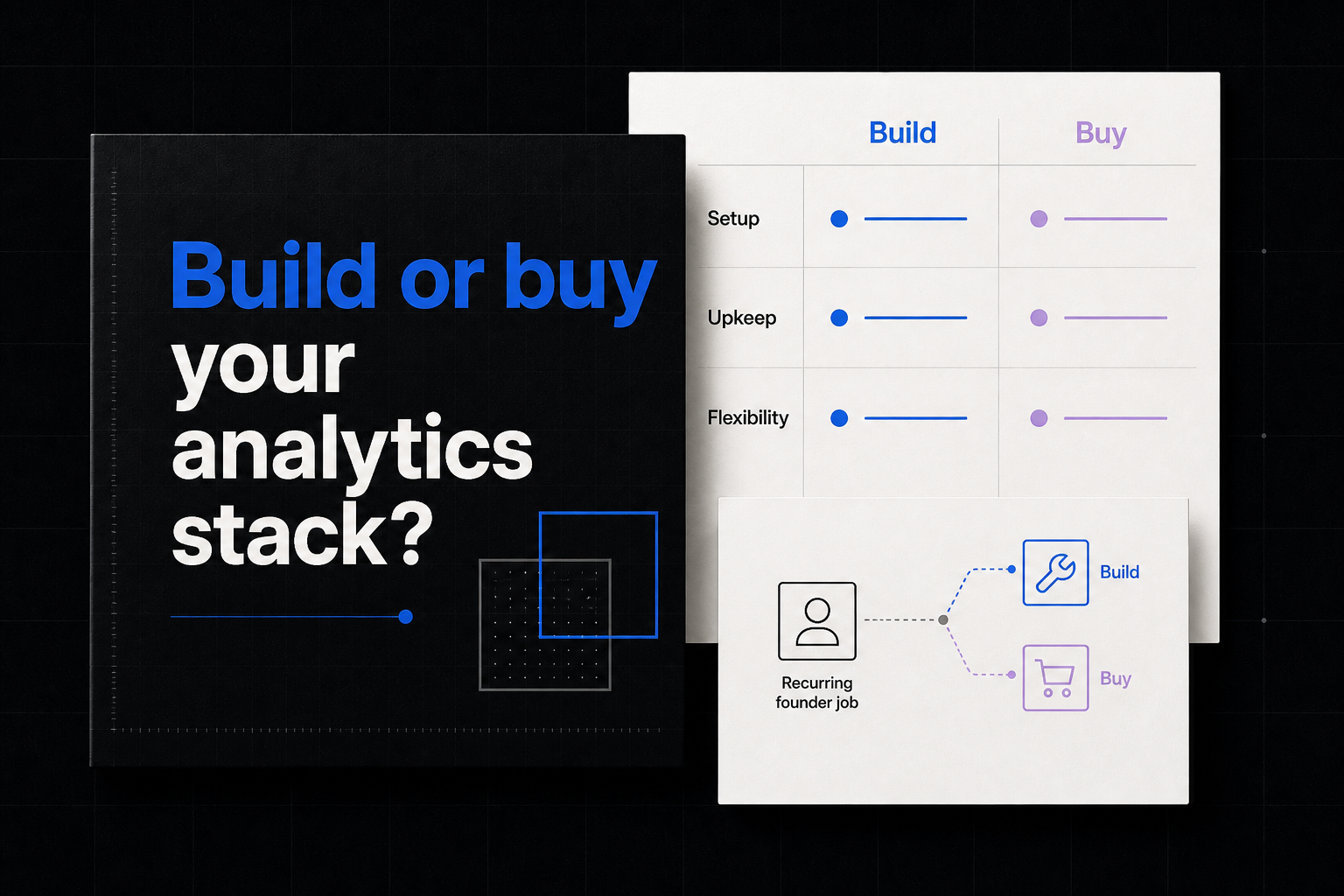
“Build or buy?” is too early a question. First define the recurring reporting job, the sources it must preserve and the person who will own it after the first week.
A spreadsheet can be the right answer. A warehouse can be the right answer. A focused reporting layer can be the right answer. Compare them on the same operating requirements.
Define the job
Write the output before selecting the architecture:
Every Monday, show one complete customer journey from discovery to retained revenue, with source freshness, definitions, an MRR bridge and direct links for one investigation. Preparation should take less than 30 minutes and have a named owner.
Record:
- sources and accounts;
- measures and entities;
- reporting window/timezone;
- refresh expectations;
- identity joins;
- revenue definition;
- user/access requirements;
- diagnostic depth;
- disclosure/security constraints;
- acceptable ongoing maintenance.
If the requirement is “all data in one dashboard,” every option will sprawl.
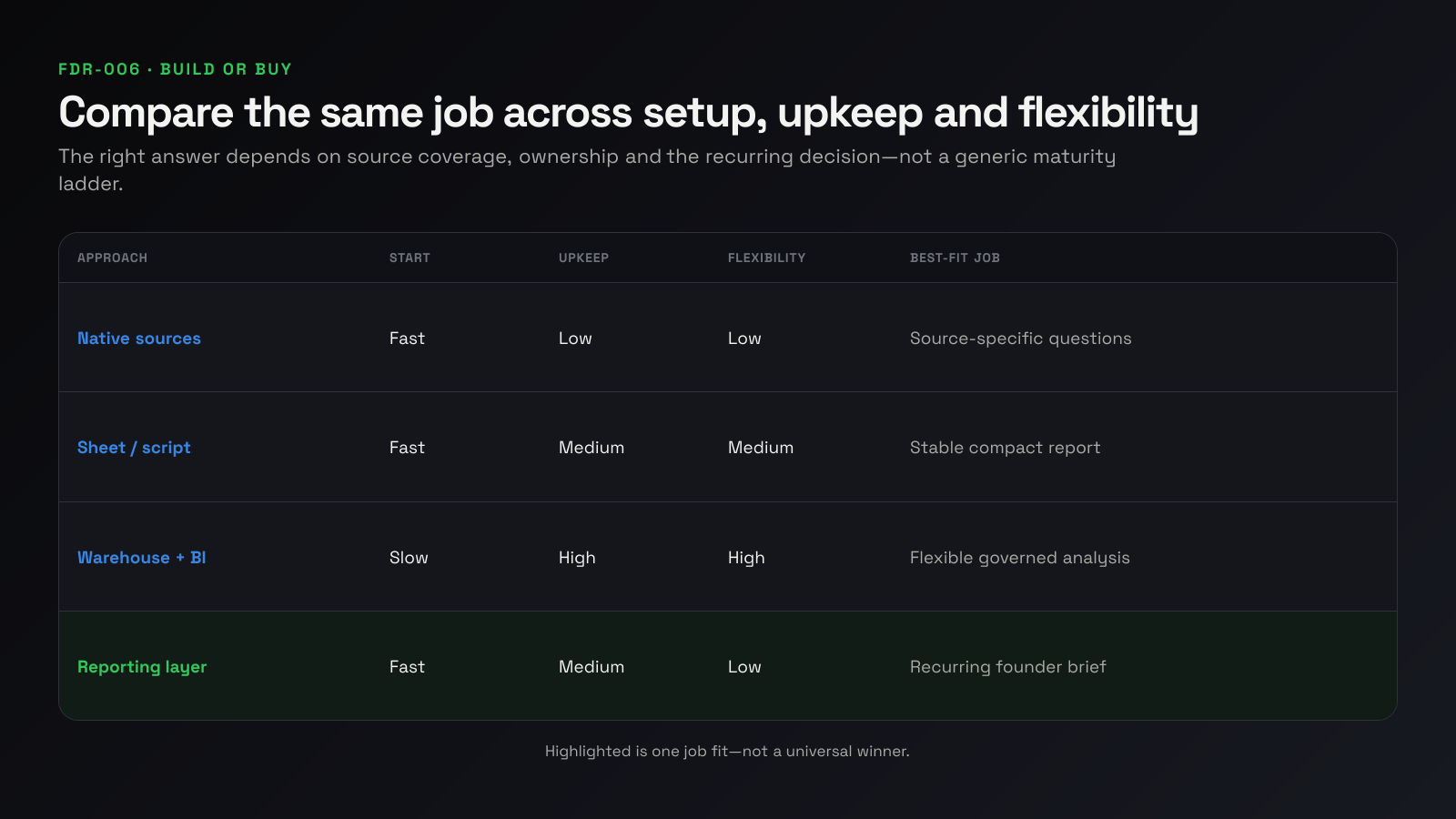
Compare four approaches
| Approach | Best fit | Main ownership |
|---|---|---|
| Native source dashboards | One or two sources; questions stay source-specific | Founder/operator |
| Spreadsheet or script | Stable, compact recurring report with technical owner | Builder plus report owner |
| Warehouse + BI | Flexible cross-team analysis and governed modeling justify complexity | Data/engineering |
| Founder-reporting layer | Repeated cross-source operating brief; source tools remain diagnostic | Product/vendor plus founder |
These are not maturity levels. Moving from a spreadsheet to BI is not automatically progress.
Count the full cost of building
Initial build work includes:
- authentication and credential storage;
- API/export ingestion;
- pagination, backfills and rate limits;
- schemas and source mappings;
- currency, timezone and identity rules;
- metric definitions;
- report UI and mobile behavior;
- source deep links;
- deployment, access and backups.
Ongoing work includes:
- expired credentials;
- API/schema changes;
- late or corrected events;
- duplicate ingestion;
- source discrepancies;
- broken schedules;
- security updates;
- new products/accounts;
- definition changes;
- user support and documentation.
The build is not finished when the first chart renders. It is finished only while someone keeps the report trustworthy.
Count the full cost of buying
A subscription price is only one line. Also evaluate:
- supported sources, accounts and historical import;
- exact metric definitions and exclusions;
- refresh times and failure visibility;
- customer/account identity model;
- currencies and revenue bases;
- raw access/export and deletion;
- role/access controls;
- data location, retention and subprocessors;
- setup and migration effort;
- contract/usage limits;
- vendor dependency and exit path;
- whether the workflow becomes another dashboard.
Buying transfers some implementation and maintenance. It does not transfer responsibility for business definitions or interpretation.
Use a weighted decision matrix
Score only requirements that matter to the defined job.
| Criterion | Weight | Spreadsheet | Warehouse + BI | Reporting layer |
|---|---|---|---|---|
| Source coverage | 20 | 3 | 5 | 4 |
| Weekly maintenance | 20 | 2 | 2 | 4 |
| Diagnostic flexibility | 15 | 2 | 5 | 3 |
| Definition traceability | 15 | 3 | 5 | 4 |
| Time to first useful report | 15 | 4 | 1 | 4 |
| Access/security fit | 10 | 2 | 4 | 4 |
| Exit/export | 5 | 5 | 5 | 3 |
These fictional scores show the method, not a universal result. Verify vendor capabilities and score the actual products and team.
When native dashboards are enough
Stay with sources when:
- one or two sources answer the question;
- definitions are already clear;
- cross-source joins are rare;
- the founder can complete the review quickly;
- discrepancies are easier to inspect at the source.
A one-page written brief with links can be more useful than a new system.
When a spreadsheet or script is enough
Choose it when:
- the report is compact and stable;
- source exports/APIs are manageable;
- one technical owner accepts upkeep;
- collaboration and access requirements are simple;
- the audit trail can be preserved.
Use raw/import tabs, a definition registry, validation cells and a read-only output. Keep credentials outside the sheet. Record refresh time and failures.
The warning sign is invisible ownership: a founder spends hours each month repairing a “free” report no one else understands.
When warehouse and BI are justified
Use them when:
- many teams need flexible analysis;
- event and finance models require governed transformations;
- raw history and reproducibility matter;
- analysts or engineers own pipelines and semantic definitions;
- the same modeled data supports more than the founder brief.
Do not build a warehouse solely to avoid opening four dashboards once a week unless its broader value justifies the operating cost.
When a focused reporting layer is justified
Use one when:
- the source systems already exist;
- the repeated job is selecting and aligning founder decisions;
- setup and maintenance are more expensive than diagnostic flexibility is valuable;
- direct source traceability remains available;
- the product supports the exact required integrations and definitions.
MetricsJar’s intended job is a unified founder reporting view across supported sources. It is not a general warehouse, arbitrary BI system, attribution oracle or replacement for detailed source tools.
Run a two-week manual baseline
Before buying or building:
- produce the report manually twice;
- record every source, value and definition;
- time collection, checking and interpretation separately;
- list discrepancies and diagnostics opened;
- identify which work repeats;
- estimate the owner and frequency of maintenance.
The baseline turns vague frustration into a testable requirement.
Prototype the riskiest join
Do not start with the easy chart. Test the hardest requirement:
- Stripe and app-store revenue normalization;
- account identity across product and billing;
- mature trial cohorts;
- GA4/Search Console page alignment;
- multi-account source support;
- source freshness and correction handling.
If an option cannot reproduce the source truth for that join, a polished dashboard is irrelevant.
Test failure behavior, not only the happy path
A reporting system is most valuable when one source is late, credentials expire or a definition changes. During the prototype, deliberately test:
- disconnect one non-production credential and confirm the report shows the failure;
- replay the same import and check that values do not duplicate;
- backfill a corrected transaction and see whether history updates visibly;
- rename or retire a source product and inspect the unmapped state;
- compare two source timezones across a daylight-saving boundary;
- remove a user and verify access is revoked;
- export the definitions, mappings and current report;
- trace a headline value back to the exact source record or chart.
Score how the option communicates uncertainty. A blank card or yesterday’s value without a stale label is worse than a visible partial report.
Assign ownership with a RACI-style line
For each layer, name one accountable owner:
| Layer | Accountable for |
|---|---|
| Source access | Credential scope, rotation and account selection |
| Ingestion | Refresh, duplication, late events and schema changes |
| Metric model | Definitions, mappings and version changes |
| Report | Selection, comparison and readable presentation |
| Decision | Interpretation, action and follow-up |
| Security/privacy | Access, retention, vendors and incident handling |
One person can own several lines in a small company. The point is to make the work visible. “The dashboard” cannot own itself.
For a bought product, split vendor and customer responsibility. The vendor may operate ingestion and presentation; the company still owns source authorization, business definitions, user access and decisions.
Estimate a twelve-month cost
Use a simple model:
cash cost + initial owner hours + monthly maintenance hours × 12 + expected incident/migration work
Then add the opportunity cost of delayed decisions only when you can state it responsibly. Do not invent a revenue uplift to justify either choice.
Compare at least three scenarios:
- current source/manual process;
- smallest credible build;
- smallest credible product or service.
If a custom system saves ten minutes per week but creates one unowned ingestion stack, it may lose. If a vendor cannot support the critical source or definition, low maintenance does not rescue it.
Make the decision reversible
Keep:
- source identifiers;
- metric definitions;
- mapping tables;
- historical exports/snapshots;
- credential ownership;
- configuration records;
- an exit/export path.
Avoid making one vendor’s presentation layer the only place a business definition exists.
Reassess after the workflow stabilizes
Compare:
- weekly assembly time;
- source errors caught;
- unexplained discrepancies;
- decisions produced;
- maintenance incidents;
- cost of owner time;
- diagnostic questions the system could not answer.
The winning option reduces recurring work while preserving trust. It does not need the most features.
Frequently asked questions
Is building cheaper?
Only if initial and ongoing owner time, infrastructure, security and repair work remain lower than the alternative for the required lifespan.
Is a spreadsheet unprofessional?
No. A controlled spreadsheet with stable inputs, validation and ownership can be the correct system for a small, stable report.
Does buying eliminate setup?
No. Connections, definitions, identity, revenue policy, access and validation still require work.
Should we choose BI for flexibility?
Choose flexibility when recurring questions and team usage justify its model and maintenance ownership—not as insurance against every possible future question.
What should be tested in a vendor trial?
Use your hardest real source join and reconcile it against source records. Do not judge only the demo data or visual polish.
Sources
- Founder who built a BI system for the business
- Discussion of an in-house analytics system handling 100m events
- Founder describing three self-built dashboards
- Founder describing an agent-built dashboard
- The best analytics stack for a small SaaS