Article · Updated August 2026
Find where your activation funnel leaks
Find an activation leak by defining one first-value event, measuring every handoff before it and checking the largest loss against the underlying source data. A drop is not automatically a product problem. It can come from mixed identities, incomplete events or cohorts that have not had time to finish.
Founder discussions show the practical version of this problem: 40 of 59 signups stalling at one step, people completing onboarding but never starting the core activity, and a drop revealed at an empty landing page. These examples establish that the problem recurs. They do not prove one universal cause.
Define activation before drawing the funnel
Activation is the first observable event that means the user received meaningful product value. It is not automatically signup, onboarding completion or trial start.
Write the definition down:
| Field | Fictional Acme Notes definition |
|---|---|
| First-value event | A new account connects one source and views its first completed report |
| Entity | Account |
| Eligible cohort | Accounts created during the reporting week |
| Observation window | Seven days after account creation |
| Exclusions | Staff, test and duplicate accounts |
| Owner | Product |
Choose the entity that receives the value. For a collaborative product that may be a workspace; for a single-player app it may be an account. Devices and sessions are usually poor substitutes when one person can create several of them.
Keep one definition long enough to compare cohorts. If the definition changes, annotate the date rather than splicing the old and new rates together.
Write the funnel as observable handoffs
Use events the product can actually observe. A useful product funnel might be:
- Signed up
- Created an account or workspace
- Connected the first source
- Viewed the first completed report
- Started a trial
- Converted to paid
Discovery, website visits and App Store activity can sit before this funnel, but do not force them into the same denominator unless identity and attribution genuinely connect them.
Follow one mature cohort
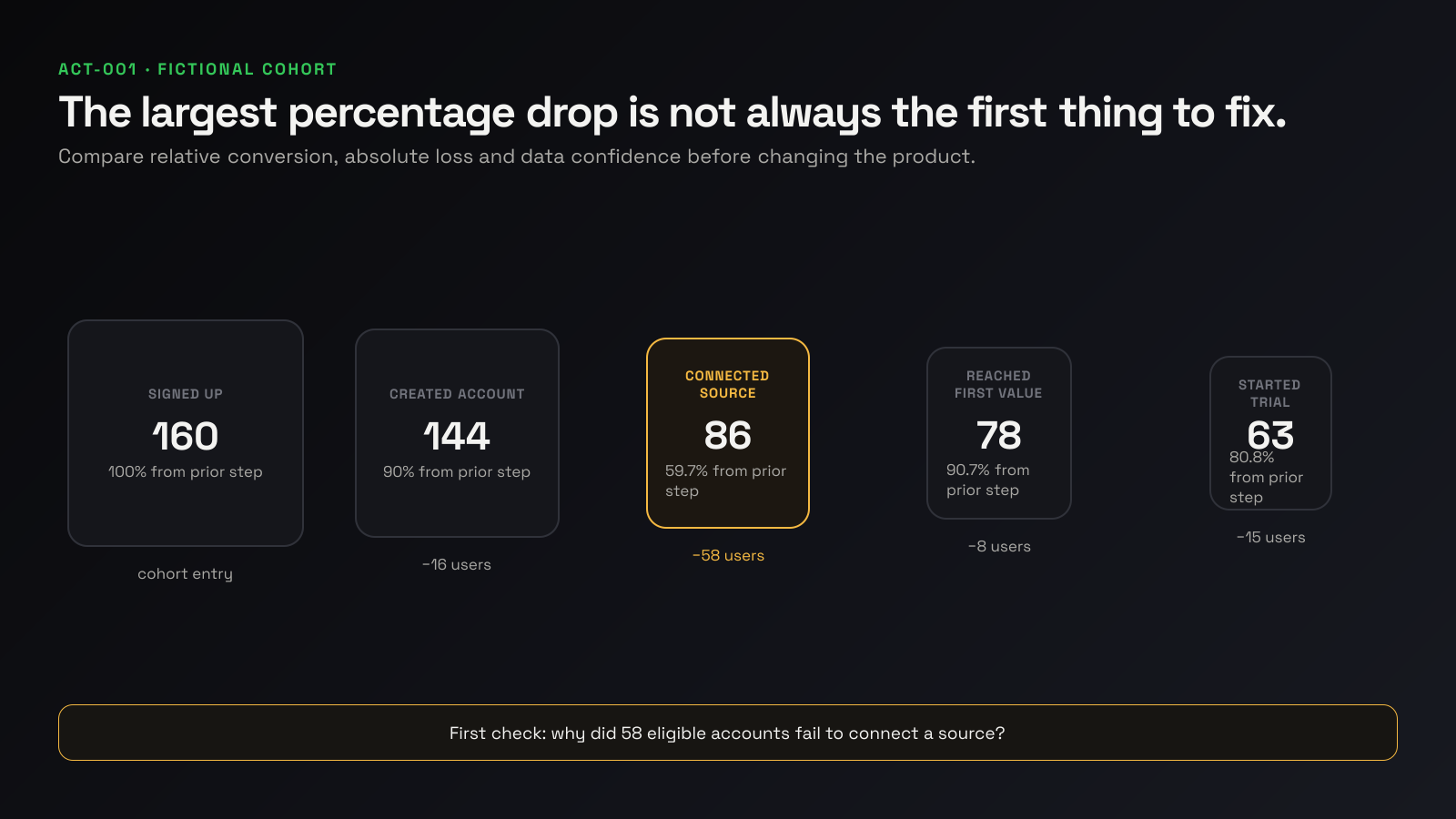
The figures below are fictional and are not a benchmark. Every account has had the full seven-day activation window.
| Handoff | Eligible | Completed | Step conversion | Absolute loss | Confidence |
|---|---|---|---|---|---|
| Signup → account created | 160 | 144 | 90.0% | 16 | Complete |
| Account created → source connected | 144 | 86 | 59.7% | 58 | Suspect event coverage |
| Source connected → first report viewed | 86 | 78 | 90.7% | 8 | Complete |
| First report viewed → trial started | 78 | 63 | 80.8% | 15 | Complete |
| Trial started → paid | 63 | 48 | 76.2% | 15 | Mature after billing window |
The largest absolute loss is 58 accounts at source connection. It also has the lowest step conversion. That makes it the first handoff to investigate—not proof that connecting a source is too difficult.
Animated diagnostic: compare absolute loss, step conversion and data confidence before changing the product.
Check measurement before changing the product
Start with the underlying records for the 58 missing accounts.
| Candidate | How to confirm it | What to do if confirmed |
|---|---|---|
| Event is missing or fires twice | Compare event records with successful connection records | Repair instrumentation and backfill where defensible |
| Device-to-account identity breaks | Trace known test journeys across anonymous and authenticated IDs | Fix the merge rule, then rerun the cohort |
| Web and app definitions differ | Compare exact event names, properties and eligibility | Create one canonical definition or report them separately |
| Cohort has not matured | Check each account’s elapsed observation window | Exclude unfinished accounts and rerun later |
| Product friction | Observe sessions or support evidence after measurement passes | Remove, explain or defer the blocking work |
| Value definition is wrong | Interview or observe users who succeed without the chosen event | Redefine activation and annotate the break |
| Audience mismatch | Compare the verified leak by acquisition source | Change targeting or promise before onboarding |
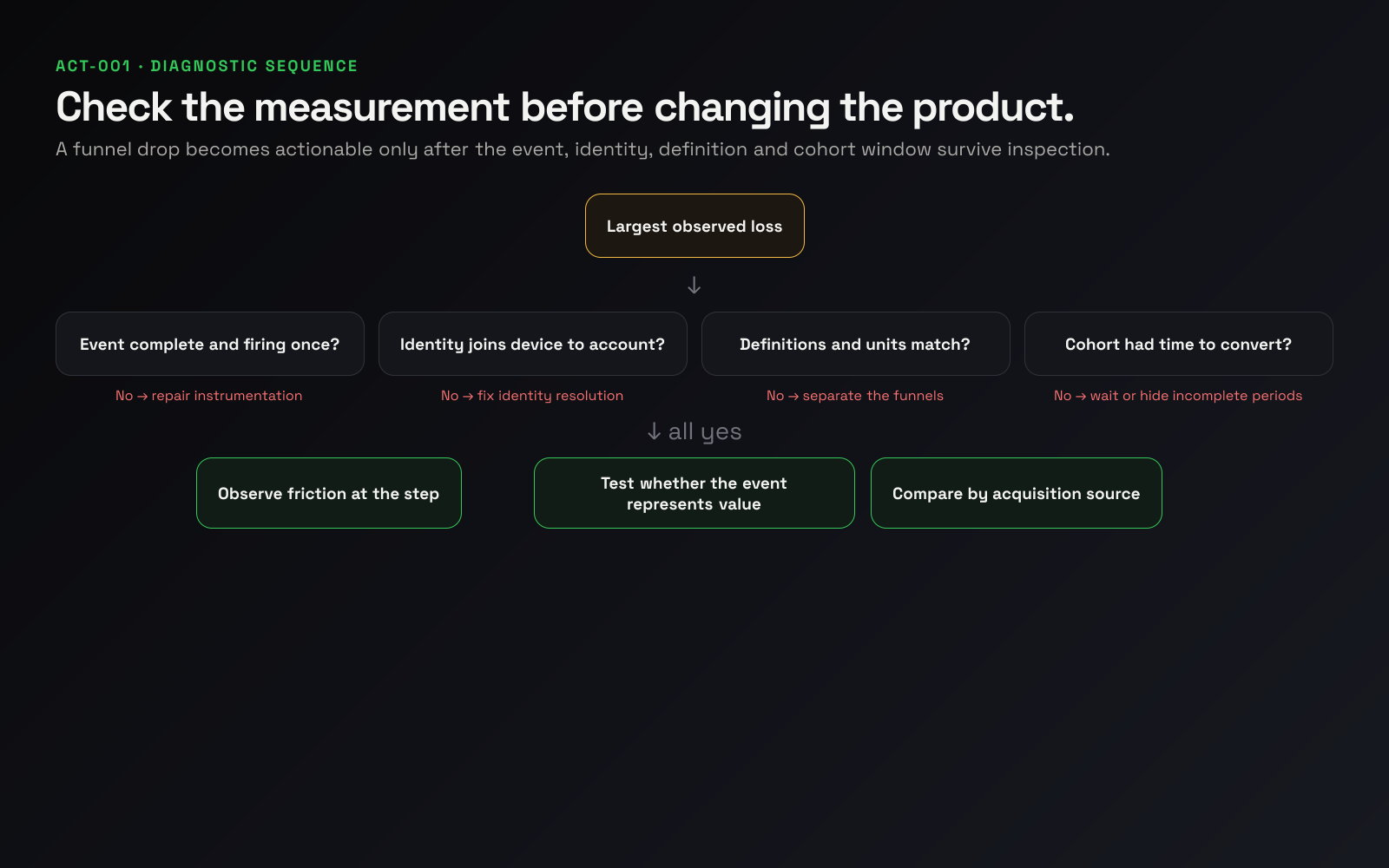
Use this order because measurement fixes change the denominator and can change the diagnosis.
How incomplete events change the conclusion
Suppose source records show that 12 accounts connected successfully but the source_connected event never arrived. The corrected count is 98, not 86.
- Account created → source connected becomes
98 / 144 = 68.1%, with 46 lost. - Source connected → first report viewed becomes
78 / 98 = 79.6%, with 20 lost.
Source connection remains the largest absolute loss, but the gap is smaller and the following handoff is weaker than the original funnel suggested. The correct action is to repair the event first, rerun the cohort, then inspect the verified product loss.
Without that check, the team could redesign the connection flow in response to a tracking defect.
Compare absolute loss and conversion rate
Conversion rate shows the severity of a handoff relative to its denominator. Absolute loss shows how many eligible accounts disappear there. Use both.
A late step can have the worst percentage but affect few accounts. An early step can have a respectable percentage and still lose the most people. Prioritize the first confirmed loss whose improvement would materially change the outcome.
Segment only when the segment changes the action. Platform, acquisition source, plan and device may be useful. A dozen tiny segments usually hide the signal.
Read the activation trio together
Three views prevent one activation number from carrying too much meaning:
- Signup or install to trial shows whether product entry becomes commercial intent.
- Activation rate shows whether eligible accounts complete the fixed first-value event.
- Median time to value shows how quickly successful accounts get there.
If activation rate is steady while time to value rises, more people may be struggling before eventually succeeding. If time to value falls while activation falls, the path may have become faster for a narrower group. Neither movement identifies a cause on its own.
Keep the cohort, entity and observation window consistent across all three.
Act only after confirming the cause
Once the failing handoff is trustworthy:
- Measurement issue: repair and backfill where possible, then rerun the cohort.
- Friction issue: observe the step and remove or clarify the blocking work.
- Value issue: test whether the event truly represents first value.
- Audience issue: compare the verified leak by acquisition source before changing onboarding.
Make one change against one confirmed diagnosis. Then compare a mature post-change cohort with the same definition.
Handle web-and-app edge cases
| Edge case | Misleading interpretation | Check | Reporting treatment |
|---|---|---|---|
| Install vs account | Every install is a new eligible user | First-time download and account records | Keep store and account funnels separate |
| Redownload | Returning device activity is new acquisition | App Store download definition | Use First Time Downloads for new downloads (Apple) |
| Multiple devices | One person appears as several users | Authenticated account identity | Use the value-receiving entity |
| Session boundaries | One journey appears as several sessions | GA4 session rules | Do not use sessions as accounts (Google) |
| Trial maturity | Recent trials look like non-converters | Billing eligibility and elapsed window | Exclude unfinished trials |
| Timezone boundary | Adjacent sources disagree by a day | Source timezone and freshness | Annotate the source boundary |
What is a good activation rate?
There is no useful universal number without a matching activation definition, entity, observation window, product category and cohort. A 60% rate for “created a workspace” is not comparable with 60% for “completed the first successful export.”
Use your own stable definition to compare mature cohorts. External benchmarks are useful only when their population and calculation genuinely match yours.
Frequently asked questions
How many funnel steps should I track?
Track the observable handoffs needed to reach first value and payment. Each step should have a distinct denominator and a possible owner. Merge steps that would lead to the same action; split a step only when the distinction changes the diagnosis.
Should activation be one event or several?
Use one fixed event for the headline activation rate. Keep supporting events for diagnosis. A compound activation score is harder to explain and easier to change accidentally.
Do I use users, accounts or workspaces?
Use the entity that receives value and can be identified consistently. In a team product that is often the workspace; in a consumer product it may be the account. State the entity beside the metric.
How long should I wait before judging a cohort?
Use an observation window long enough for a typical eligible user to reach the value event, then apply it consistently. Judge trial-to-paid only after the billing window has matured. Do not mix complete and incomplete cohorts.
What should I investigate first?
The largest confirmed, actionable loss. Confirm event coverage, identity, definition consistency and cohort maturity first. Then investigate product friction, value or audience fit.
Sources
- GA4 session definition
- App Store Connect metric definitions
- RevenueCat dashboard and metrics overview