Article · Updated August 2026
Diagnose trial-to-paid and paywall conversion
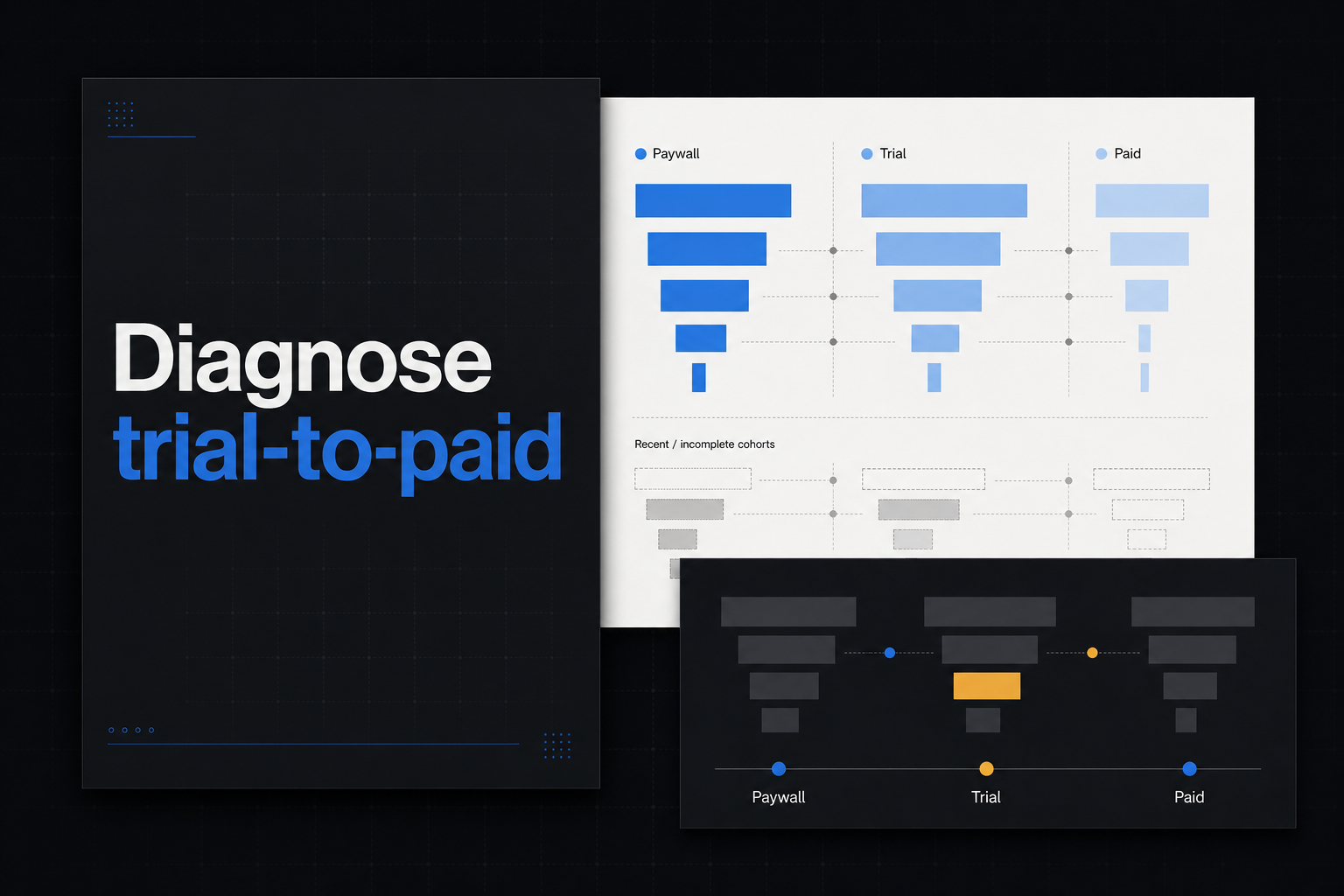
A low trial-to-paid rate can begin long before the trial. The paywall may be shown to the wrong cohort. The purchase flow may fail. Trial events may arrive twice or late. Recent trials may not have completed. A customer may convert but fail at the first renewal.
Diagnose the sequence as separate handoffs:
eligible customer → paywall exposed → purchase initiated → trial started → trial completed → paid → retained
Do not compress that sequence into one “paywall conversion” number until the denominator and observation window are explicit.
Define the funnel before reading the rate
| Stage | Entity | Event or state | Denominator | Primary question |
|---|---|---|---|---|
| Eligible | Customer/account | Meets rules for this offer | Defined eligible cohort | Who could have seen it? |
| Exposed | Customer | Paywall impression recorded | Eligible customers | Did they actually see it? |
| Initiated | Customer/session | Purchase action started | Exposed customers | Did they choose a product? |
| Trial started | Subscription/customer | Store-confirmed trial begins | Exposed or initiated customers | Did the purchase flow complete? |
| Trial completed | Trial | Trial reached its outcome boundary | Started trials old enough to complete | Is the cohort mature? |
| Paid | Subscription/customer | First paid transaction | Completed trials | Did the trial convert? |
| Retained | Subscription/customer | Renewal or retained paid state | Paid cohort old enough to renew | Did the paid value stay? |
The entity can change along the path. A paywall view can be a session event, while a paid conversion belongs to a customer and subscription. Join them deliberately.
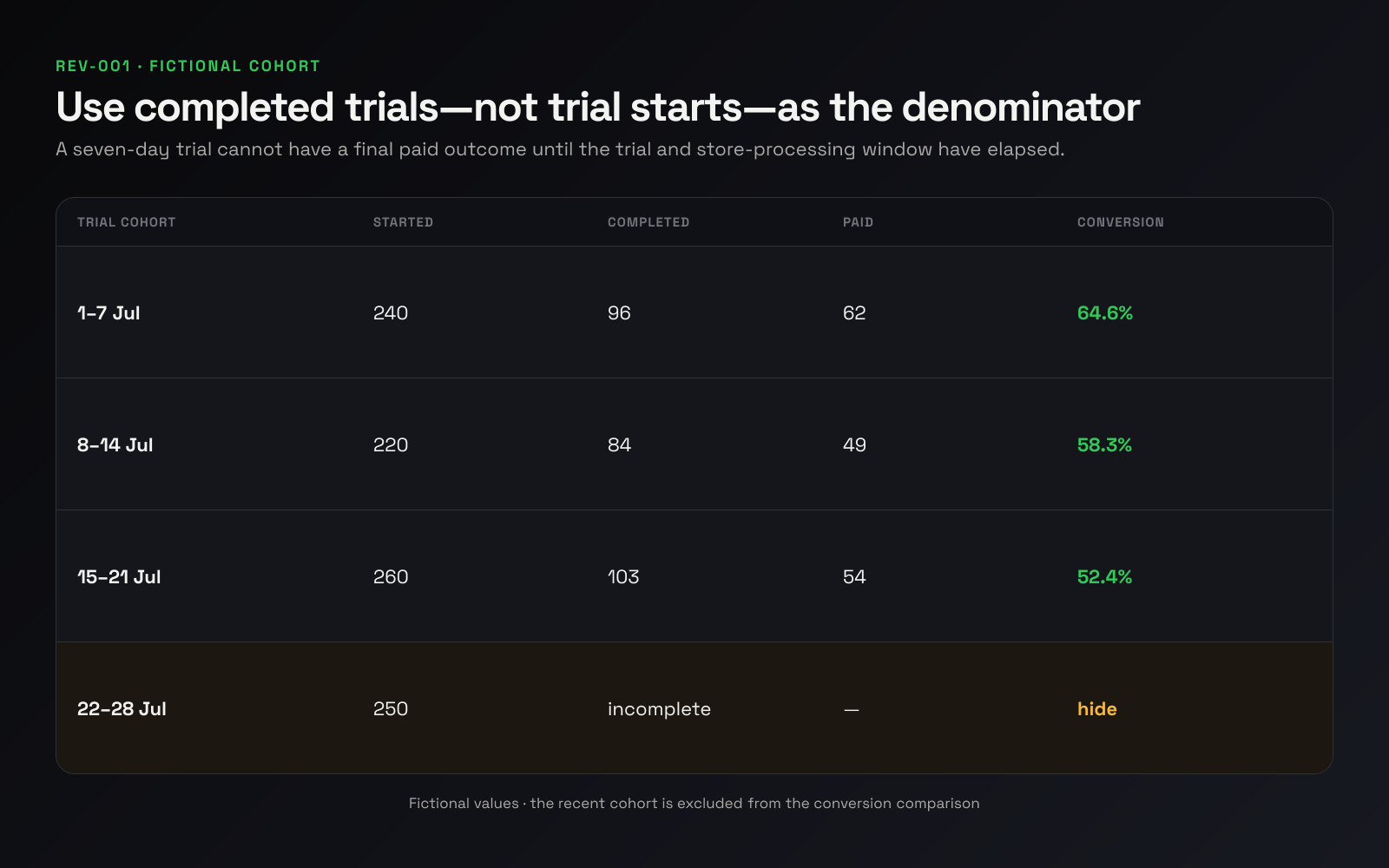
Use completed trials as the conversion denominator
RevenueCat defines trial conversion rate as converted trials divided by completed trials, and notes that trial conversion events lag trial starts by the trial duration. A conversion can also arrive later on the expiration day because the store must process and report it (RevenueCat).
Apple similarly defines trial-to-paid conversion as the percentage of completed trial offers that converted to a paid subscription (Apple).
That means this calculation is usually wrong for a current period:
paid conversions this week / trial starts this week
It mixes people who started and completed at different times. Use cohort logic:
paid conversions from cohort / completed trials from the same cohort
Hide or label recent cohorts until the full trial plus processing delay has elapsed.
Locate the first weak mature handoff
Calculate each step separately:
| Rate | Calculation | Diagnostic job |
|---|---|---|
| Exposure rate | Exposed / eligible | Targeting and delivery |
| Paywall action rate | Initiated / exposed | Offer comprehension and intent |
| Trial-start rate | Trials started / exposed | Purchase flow and offer uptake |
| Trial completion rate | Completed / started | Cohort maturity and early cancellation context |
| Trial-to-paid rate | Converted / completed | Trial value and payment outcome |
| First-renewal retention | Renewed / paid eligible to renew | Continued value and payment recovery |
A trial-to-paid problem should not be diagnosed from paywall screenshots when the largest loss occurs before a customer ever sees the paywall.
Verify exposure
For an experiment, assignment is not exposure. RevenueCat’s experiment results distinguish enrolled customers from customers who actually saw the paywall. It warns that including unexposed customers dilutes the measured effect; custom paywalls must call the supported impression-tracking method, while RevenueCat Paywalls track exposure automatically (RevenueCat).
Check:
- the paywall impression fires once per actual exposure;
- the customer has a stable ID before exposure when possible;
- placement and offering are recorded;
- eligibility and targeting rules are versioned;
- background loads do not count as views;
- repeat views are distinguished from unique viewers.
If the exposure event is unreliable, stop. Fix it before comparing variants.
Verify the purchase and trial events
Do not infer a trial start from a button tap. Confirm it from the store or subscription source.
For each trial, preserve:
- customer and subscription identifiers;
- product, store and offer;
- start and expected completion timestamps;
- cancellation, billing retry and grace-period state;
- first paid transaction or expiry outcome;
- experiment variant and actual exposure status, when relevant.
Duplicate webhooks, sandbox transactions and reinstall identity can distort small cohorts. Reconcile event counts against the authoritative subscription source.
Separate cancellation from access loss
A customer who disables renewal during a trial may retain access until the trial ends. “Cancelled” can mean the renewal intention changed, not that the subscription is already inactive.
Track state transitions rather than one boolean:
| State | Meaning | Founder action |
|---|---|---|
| Trial active, renewing | Trial has not ended; renewal remains enabled | Observe product value |
| Trial active, cancelled | Trial access remains, but renewal is disabled | Diagnose early intent loss |
| Billing issue/grace | Store could not complete payment; access rules vary | Recover payment |
| Paid active | At least one paid transaction; access active | Measure retained value |
| Expired | Access period ended without active entitlement | Classify voluntary/involuntary outcome |
This avoids calling every cancellation immediate churn.
A worked diagnosis
The following data is fictional. Acme Coach has a seven-day trial and waits an additional day for store processing before closing a cohort.
| Mature cohort | Eligible | Exposed | Trial started | Trial completed | Paid | First renewal |
|---|---|---|---|---|---|---|
| 1–7 Jul | 600 | 420 | 240 | 96 | 62 | 49 |
| 8–14 Jul | 580 | 390 | 220 | 84 | 49 | 39 |
| 15–21 Jul | 650 | 455 | 260 | 103 | 54 | Not mature |
For 15–21 July:
- exposure rate:
455 / 650 = 70.0%; - trial-start rate from exposure:
260 / 455 = 57.1%; - trial-to-paid conversion:
54 / 103 = 52.4%.
The trial-to-paid rate fell from 64.6% in the first cohort to 52.4% in the third. That pattern deserves investigation, but it is not yet a cause. Segment by product, placement, country, store, acquisition source and app version only when the subgroup remains large enough to interpret.
Then inspect what changed:
- Was the exposed cohort mix different?
- Did the offer, price, trial length or paywall change?
- Did a product or onboarding release affect first value during the trial?
- Did payment failures, refunds or store reporting delay increase?
- Did instrumentation or identity change?
Diagnose by failure shape
| Observed shape | First checks | Do not conclude yet |
|---|---|---|
| Low exposure among eligible customers | Targeting, placement delivery, impression tracking | The paywall copy is weak |
| Exposure stable; purchase initiation falls | Product mix, price display, CTA, eligibility | Price caused the change |
| Initiation stable; trials started fall | Store errors, purchase flow, offer eligibility | Users rejected the offer |
| Trials start; completed-to-paid falls | Trial value, cancellation timing, payment state, cohort maturity | Trial length is wrong |
| Paid conversion stable; renewal falls | Continued value, billing recovery, plan mix | Acquisition quality is the cause |
Use wording such as “can indicate.” The funnel directs the next check; it does not establish causation.
Run a clean paywall experiment
RevenueCat supports tests across price, trial presence or length, product mix and paywall design, using two to four variants (RevenueCat). A clean experiment still requires a precise hypothesis.
Write:
For eligible new customers at the onboarding placement, changing the annual-plan presentation will improve 30-day realized revenue per exposed customer without reducing paid-customer retention.
Then define:
- one primary decision metric;
- guardrails such as refunds or first-renewal retention;
- exposure rules;
- stable customer assignment across devices;
- the minimum observation period;
- segments chosen before reading results;
- the stopping rule.
Do not select a winner from trial starts when the business outcome is paid or retained revenue. RevenueCat notes that an offer can reduce initial conversion while producing higher realized value per paying customer. Follow the lifecycle far enough for the decision.
Keep the weekly report small
Show:
- eligible and exposed customers;
- mature trial starts, completed trials and paid conversions;
- first-renewal outcome for mature paid cohorts;
- instrumentation health;
- one current experiment or diagnostic;
- incomplete cohorts clearly hidden or shaded.
Detailed customer, transaction and error investigation belongs in the subscription and store sources. The founder report keeps the handoffs visible.
Frequently asked questions
What is a good trial-to-paid conversion rate?
This article does not publish a universal benchmark. Rates depend on eligibility, trial design, product, price, platform, acquisition mix and denominator. Compare consistently defined mature cohorts before seeking an external benchmark.
Should trial conversion use starts or completed trials?
Use completed trials from the same cohort. Recent trial starts have not had the opportunity to convert.
Is a paywall view the same as experiment enrollment?
No. Enrollment assigns a variant. Exposure means the customer actually saw the paywall. Analyse exposed customers when the decision concerns paywall performance.
Should I optimize trial starts or paid revenue?
Use trial starts as an early diagnostic. Choose a decision metric that reflects the business outcome, such as mature paid conversion, realized revenue or retained paid customers.
Why do App Store Connect and RevenueCat disagree?
Check metric definitions, cohort dates, store processing, customer identity, refunds, currencies and product filters. The tools can answer different questions while both remain correct.
Sources
- Apple subscription analytics and trial-to-paid definition
- RevenueCat charts overview
- RevenueCat experiment results and metric definitions
- RevenueCat experiments overview
- RevenueCat offerings
- Discussion about paywall-view to purchase conversion
- Discussion about inconsistent trial events